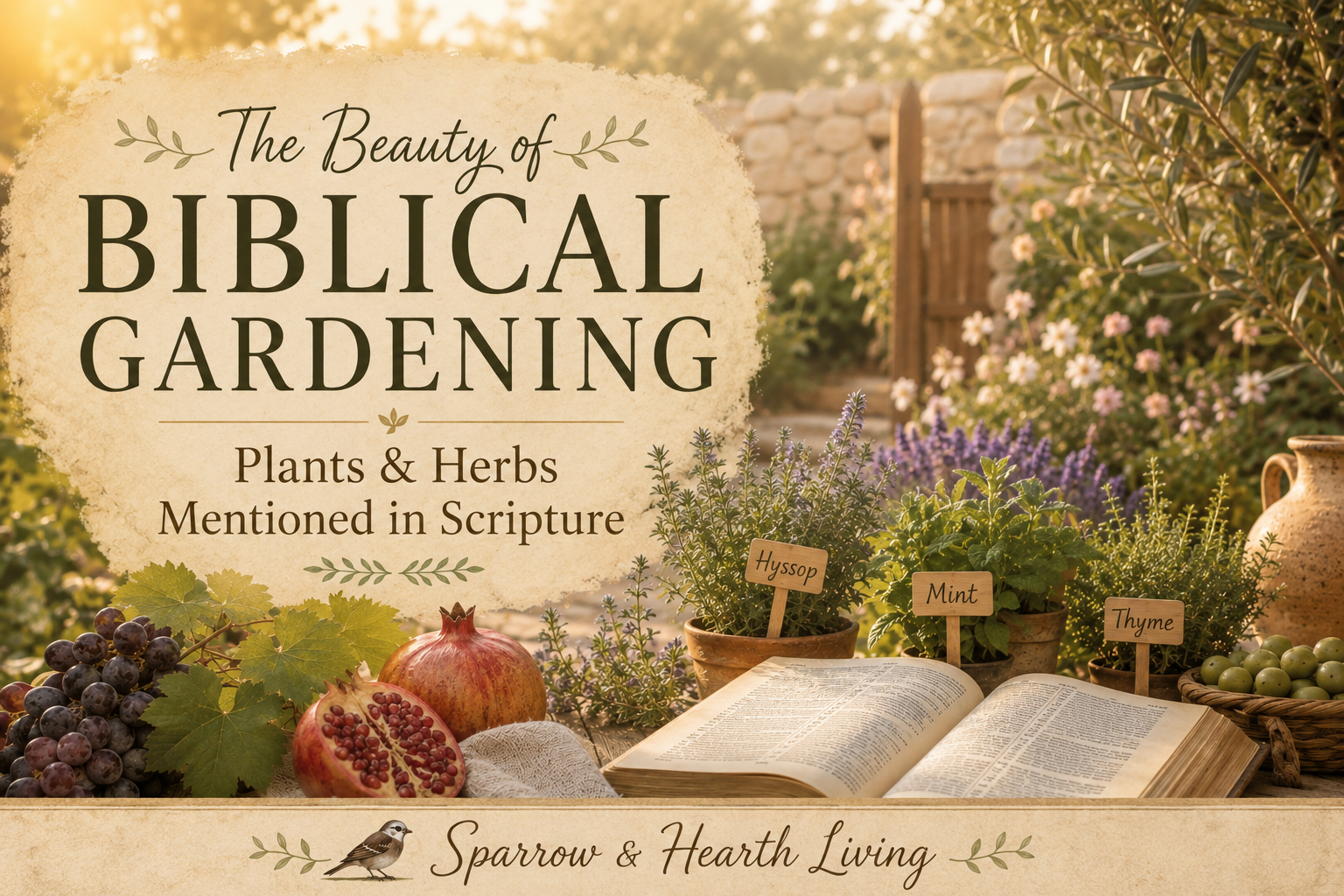
Discovering God’s presence in the garden, one plant at a time.
There is something deeply peaceful about working in a garden. The quiet rhythm of pulling weeds, watering thirsty plants, and watching tiny seeds become flourishing life reminds us that God is always at work—even when we cannot see it.
As I’ve spent more time tending my own garden, I’ve found myself wondering what the gardens of the Bible might have looked like. What herbs grew along the paths? What trees provided shade? What flowers covered the hillsides? Scripture is filled with references to gardens, vineyards, olive groves, and fragrant herbs. From Genesis to Revelation, God uses plants to teach us about faith, growth, provision, and His unchanging love.
Whether you have acres of land or a few pots on your porch, growing even a handful of biblical plants can become a beautiful reminder of God’s Word every time you step outside.
God Began the Story in a Garden
The very beginning of the Bible takes place in a garden.
“And the Lord God planted a garden in Eden, in the east, and there he put the man whom he had formed.” — Genesis 2:8 (ESV)
Before there were cities, kingdoms, or churches, there was a garden. It was a place where God walked with His people, where every need was provided, and where creation reflected His perfect design.
Gardens have always been places of beauty, work, and worship. Even after sin entered the world, God continued to use gardens throughout Scripture as places of growth, prayer, and restoration.
Perhaps that’s why so many of us feel closest to Him while digging in the soil.

1. Mint
Fresh, fragrant, and easy to grow, mint appears in Jesus’ teaching about the Pharisees.
“For you tithe mint and rue and every herb, and neglect justice and the love of God.” — Luke 11:42 (ESV)
The Pharisees were meticulous about giving even tiny garden herbs to God, yet they missed the greater matters of compassion and righteousness.
Garden Lesson
Growing mint reminds us that God desires hearts that love Him more than outward appearances. Faith is about obedience that begins within.
Growing Tip
Mint spreads quickly, so plant it in a container unless you want it to take over an entire bed.

2. Mustard
Jesus often used mustard seeds to describe the Kingdom of God.
“If you have faith like a grain of mustard seed…” — Matthew 17:20 (ESV)
The mustard seed is incredibly small, yet it grows into a large plant.
Garden Lesson
Never underestimate the small beginnings God places in your life.
Tiny prayers.
Tiny acts of obedience.
Tiny seeds.
God delights in growing small things into something beautiful.

3. Hyssop
Hyssop appears throughout Scripture in moments of cleansing and worship.
David prayed,
“Purge me with hyssop, and I shall be clean.” — Psalm 51:7 (ESV)
Hyssop was also used during the first Passover when the Israelites spread lamb’s blood on their doorposts.
Garden Lesson
Hyssop reminds us of forgiveness, redemption, and the cleansing only Christ provides.
Its silvery-green leaves make it a lovely addition to herb gardens today.

4. Olive Trees
Olive trees are mentioned hundreds of times throughout the Bible.
Olive oil provided food, medicine, light, and anointing.
Paul writes,
“Some of the branches were broken off, and you, although a wild olive shoot, were grafted in…” — Romans 11:17 (ESV)
Garden Lesson
The olive tree represents endurance, peace, and God’s covenant faithfulness.
Though many of us can’t grow olive trees depending on our climate, they remind us to stay rooted in Christ.

5. Fig Trees
The fig tree appears repeatedly throughout Scripture.
Jesus often taught using fig trees because His listeners saw them every day.
The fig tree became a symbol of spiritual fruitfulness.
Garden Lesson
God desires lives that produce fruit—not perfection, but steady growth.
Just as a healthy tree naturally bears fruit, a heart rooted in Christ gradually reflects His character.

6. Grapevines
Jesus gave one of His most comforting illustrations using a vineyard.
“I am the vine; you are the branches.” — John 15:5 (ESV)
Branches cannot survive apart from the vine.
Neither can we.
Garden Lesson
A flourishing garden depends on constant nourishment.
So does our faith.
When we remain connected to Christ through prayer, Scripture, and obedience, He produces fruit in our lives.

7. Lilies
Jesus pointed to wildflowers when teaching about God’s care.
“Consider the lilies of the field, how they grow…” — Matthew 6:28 (ESV)
Lilies do not strive or worry.
Yet God clothes them with incredible beauty.
Garden Lesson
Flowers remind us that God notices every detail of His creation—including us.
If He faithfully cares for the flowers, how much more will He care for His children?

8. Cedar Trees
The mighty cedars of Lebanon symbolized strength and stability.
Psalm 92 says,
“The righteous flourish like the palm tree and grow like a cedar in Lebanon.” — Psalm 92:12 (ESV)
Garden Lesson
Strong roots create strong trees.
Our spiritual roots grow deeper each time we spend time with God.
Storms may come, but deeply rooted faith remains.

9. Pomegranates
Pomegranates decorated the garments of Israel’s priests and even Solomon’s Temple.
Their abundance of seeds made them symbols of fruitfulness and blessing.
Garden Lesson
God often multiplies what we faithfully place into His hands.
One act of obedience can bear fruit for generations.

10. Almond Trees
The almond tree is one of the first trees to bloom after winter.
In Jeremiah, God uses the almond branch as a picture of His watchfulness over His promises.
Garden Lesson
Even when winter seems long, spring is coming.
God is always faithful to fulfill His Word in His perfect timing.
Creating Your Own Biblical Garden
You don’t need a large homestead to enjoy a biblical garden.
Start with a few simple plants:
- Mint
- Thyme
- Rosemary
- Sage
- Lavender
- Hyssop
- Mustard greens
- Grapevines (if space allows)
- Fig tree (in warm climates or a container variety)
- Olive tree (where climate permits or as a patio container)
As you tend these plants, let them become reminders of the truths found in Scripture. Place small garden markers with Bible verses beside them or keep a journal of what God teaches you during your time outdoors.
A biblical garden isn’t about recreating ancient Israel. It’s about creating a space where your hands are busy, your heart is quiet, and your mind is fixed on the Lord.
Growing Faith Alongside Your Garden
One of my favorite things about gardening is how often it slows me down enough to notice God.
Seeds don’t sprout overnight.
Flowers don’t bloom the day they’re planted.
Fruit takes time.
Our faith grows much the same way. God patiently cultivates our hearts through seasons of waiting, pruning, and growth. Sometimes we can’t see what He’s doing beneath the surface, but just like a seed hidden beneath the soil, He is always at work.
Every weed pulled reminds us to remove the things that draw us away from Him. Every bloom is a picture of His faithfulness. Every harvest is a reminder that God provides in His perfect timing.
When we step into our gardens, we’re invited to remember the Creator who designed every leaf, every flower, and every season.
A Prayer for the Gardener
Heavenly Father,
Thank You for revealing Your goodness through Your creation. As I tend the garden You’ve entrusted to me, help me also tend the garden of my heart. Teach me patience as I wait for growth, faith as I trust Your timing, and gratitude for every blessing You provide. May every seed I plant remind me that You are always working, even when I cannot yet see the harvest. Draw me closer to You through the quiet moments outdoors, and let my life bear fruit that brings You glory.
In Jesus’ name, Amen.
Scripture for Reflection
“The earth is the Lord’s and the fullness thereof, the world and those who dwell therein.” — Psalm 24:1 (ESV)
Whether you’re planting herbs in a small container, tending raised beds, or simply enjoying the beauty of wildflowers along a country road, let your garden become a place where faith takes root. As you care for the plants God has placed in your hands, may He continue cultivating a heart that grows ever closer to Him.
Leave a Reply